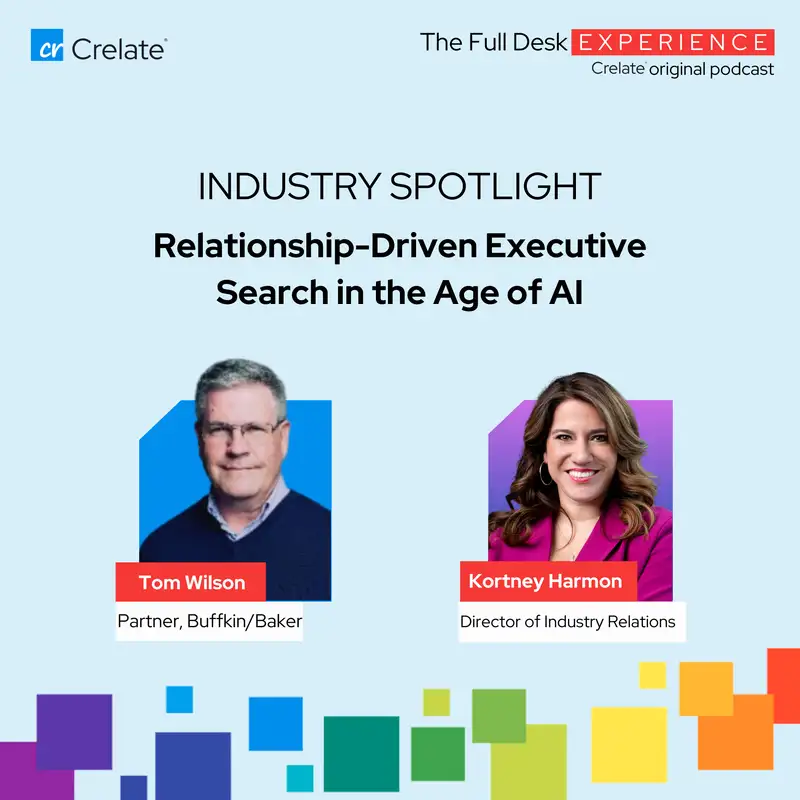
Industry Spotlight | Relationship-Driven Executive Search in the Age of AI with Tom Wilson, Partner- Buffkin/Baker
Tom Wilson [00:00:00]:
We are bringing them insights based on what we know and who we know. Right. And I'm never going, if I'm working, you know, if I'm pitching for a CMO search or something like that, chief Marketing officer search, I'm never going to out market the Chief Marketing officer. Right. I don't know as much about that space as they do. But what I do know is, you know, what's going on at other companies because I've spoken to other chief marketing officers or, you know, CFOs or whatever the role is. That's the info that they're interested in learning.
Kortney Harmon [00:00:30]:
Hi, I'm Kortney Harmon, Director of Industry Relations at Crelate. This is the Industry Spotlight, a series of the Full desk experience, a Crelate original podcast. In this series, we will talk with top leaders and influencers who are shaping the talent industry, shining a light on popular trends, the latest news and the stories that laid the groundwork for their success while welcome back to another episode of the Full Desk Experience Industry Spotlight. As we look ahead into 2026, one of the biggest themes for us on the podcast is relationships. How they evolve, how they strengthen, why they matter more than ever. In a world that is increasingly shaped by automation and AI. I am very excited to be joined by Tom Wilson, partner at Buffkin Baker and a firm known for its work across diverse sectors including technology, higher education, executive leadership. And I've gotten to know Tom a little bit and he brings such a thoughtful, human centered perspective to executive search.
Kortney Harmon [00:01:36]:
Really balancing processes, long term relationships, talking clients and candidates, and really helping drive his firm to success. So my goal in this conversation, we're going to really explore how the recruiting process has changed across industries, how firms adapt to shifting client needs, and what the future of a modern executive search firm looks like as we continue to evolve the art and science of recruiting. So, Tom, thank you so much for spending your afternoon or your morning, I should say, with me to record for today. Thank you so much.
Tom Wilson [00:02:11]:
Yeah, thank you, Kortney. Very excited to be here.
Kortney Harmon [00:02:13]:
Absolutely. So do me a favor. Our audience doesn't know necessarily. Some of them, they about you. So do me a favor and tell me about your journey as you got into this industry, kind of where, how you've evolved to where you are today.
Tom Wilson [00:02:26]:
Yeah, thanks. You know, it's interesting because I my very first real job after grad school is with an executive search firm. So, you know, being the, the junior person on, you know, doing the research and you know, then as an associate, did that for about three years with the Wall street firm that later got bought by Heidrick and struggle. So kind of that big firm experience and then, and then went in house for almost 20 years, you know, within large corporations, either in recruiting roles or HR leadership roles within these companies and particularly in the recruiting roles. I had the opportunity to hire dozens, if not hundreds of search firms for specific searches across our businesses. And it really gave me an appreciation for, I knew how search worked from the inside, at least my little piece of it. But I also got to, to understand what as a buyer of search, what I like and what I don't. And so that really formed my, my views about how I operate now.
Tom Wilson [00:03:25]:
And so I had the opportunity in 2018 to come back into search with a company called Frederickson Partners, which is an HR specialist search firm that was based in Silicon Valley. Fast forward a number of years and we've recently been acquired by Buffkin Baker. So that, that's where I am now. So effectively it's the, you know, largely the same team that you know with me from, that came in from Frederickson, but you know, now part of a great organization, very aligned with how I've always wanted to operate as a search person and as an HR leader. And it's, it's great. So you know, Buffin Baker, we're at the firm, I lead the tech sector, the tech industry sector and we also have four other areas of emphasis. We do a lot of search in higher education. We cover healthcare from a clinical perspective, so hospital systems and the like.
Tom Wilson [00:04:13]:
We also have a private equity practice which has a deep focus on investor led healthcare companies, particularly around imaging and things like that. And then our last practice is consumer and retail and hospitality. So it's a very, as you mentioned in your kickoff, it's a very broad thing from tech to hospitals to higher ed, kind of everything in between.
Kortney Harmon [00:04:35]:
I love that. And you've been at Bufkin for how long? Or I guess Frederick and Bufkin kind of.
Tom Wilson [00:04:41]:
Well, yeah, I joined Frederickson in 2018 and then Buffin acquired us as well as other search firms earlier this year, in February of this year.
Kortney Harmon [00:04:49]:
I love it. What an exciting journey. And I love that you have the lens of from the search firm, but also what you would want working with a search firm. You have a unique ability to see both sides of that coin.
Tom Wilson [00:05:02]:
Yeah, it really informs how I operate as a search leader and what is the product that we give to our clients. And honestly, it's important for me, when I originally joined Frederickson, that had to be aligned, right? It had to be a Client first and a candidate first environment. That's also with Bufkin Baker, it's the same type of. We're amazed at how well our values and our operating model and, you know, the ways that we like to work align. So that's great.
Kortney Harmon [00:05:32]:
I love it. And that's amazing. And I. You talked about different sectors and I've been hearing a lot from my perspective of obviously we're going to talk human connection, but also scale and growth in the environment we're in. So I love the idea. As we talk about the diverse sectors that Buffkin Baker serves, I want to know, how do you adapt your recruiting processes for different industries like technology versus higher education? Is there a different nuance? How are you. How is your firm treating that to help them be successful?
Tom Wilson [00:06:04]:
Yeah, that's a great question, Kortney. And you know, each, each industry or sector has its own rhythm in working in the tech sector and financial services, particularly investment banking, where I'd spent most of my career prior to search, it's very fast paced. Right. You gotta have it now, gotta get done, you know, even at the expense of some process. And. Yeah, and I'd say same. Yeah, that's kind of similar around the consumer goods space. Right.
Tom Wilson [00:06:27]:
They want to move very, very quickly. You know, other search processes are very structured, particularly higher ed. Even some of the healthcare searches where they'll, you know, they'll have search committees, they'll have the whole thing planned out. You know, your average search length is a multiple of the length that, you know, in some of the other sectors in terms of months and, you know, but ultimately executive search is just fundamentally the intersection of like a process, the discipline you have about it and your network. Right. And so, you know, we look for tools that can support us across those things. And, you know, Crelate's a great example. You know, it's a great system and.
Tom Wilson [00:07:06]:
Yeah, and it works equally well for a, you know, a technology industry search that might take 60 days, as it does for a higher ed search that might take, you know, six months. So we of course do modifications in terms of the, some of the candidate flows and things like that. But ultimately, you know, search is not so specialized of a process that you can't make it fit into existing tools. Yeah, but we also have some other kind of other tools around AI note takers and sourcing tools and the like, which they're very. You don't, for example, you don't use that AI sourcing tool in higher ed because you've got other tools that, that give you the data you need around candidates. So. Yeah, but ultimately the process is the same.
Kortney Harmon [00:07:46]:
I love it processes and obviously the speed at which we work is just kind of the name of the game, depending where you're at. I love it. Have you noticed or maybe I guess should say, what are the biggest differences you've seen with candidate expectations? Because as we work with candidates, I, I can tell you from when I was running a desk in technology to probably what it is today. Yeah, I heard someone make the reference that we're not judging our candidate experiences off of the last job we got hired for, but more the Amazon prime experience or, you know, candidates, their expectation for their hiring process is different. So do you notice that different in sectors or maybe just in general how you've seen it change over the past few years?
Tom Wilson [00:08:36]:
Yeah, and I think that it's. The Canada experience is probably unique to each sector. Right. So. And I just. So for example, I'm working now as a kind of a joint venture search with our higher ed practice for, you know, a search for a, you know, a big university, you know, C level role where, you know, I'm really kind of participating in that higher ed search for the first time. And just the expectations of the client are different, right. In terms of timing and how long it takes.
Tom Wilson [00:09:03]:
And frankly, the candidates know this, right. If you're in higher ed, you kind of know how it works so, you know, to move from one university to another. So I think that's the first thing is that, you know, each, each sector has a certain seasonality around it, right. And it could be based on, you know, academic calendars, compensation cycles, you know, fiscal years, how those work in different industries or types of organization. But, you know, it all boils down to the candidate, right? And if you give a good candidate experience by setting expectations like this is how long it's going to take and this is when we'll keep in touch with you or if you have a question, just text and I'll get back to you as soon as I can. That's the most important thing. And going back to what I was saying before about how I like to operate is I've also been a candidate in a lot of executive searches, right. And have had, I would say, wildly variable experiences of really good ones to frankly, really bad ones.
Tom Wilson [00:09:56]:
And so I also keep that in mind that for us, the candidates are just as important as the clients and we need to let the candidates know that we care about you as professionals, as people that are involved in this transaction. We're working on but ultimately it's about the long term relationship because keeping them informed and turning them off and all those things, it's not just the right thing to do, it's just good business sense because they'll be the ones that come back to us with new searches. The clients will too. But frankly, there's a lot more candidates than there are clients.
Kortney Harmon [00:10:31]:
And honestly, let's face it, in our world that we work in, it's very much your today's candidate is tomorrow's client. When they have that good experience, they're going to continue to come back because they notice that difference. So, yeah, I love, I love setting the clear expectations because oftentimes this industry is very much firefighting and reactionary by default just because there are so many irons in the fire. So that is a great basic awareness of know one thing to pay attention to as we continue because that builds relationships. It's not just the transactional. Sometimes we get to the point also where it's, I just need to fill this job here today. But that's, that's not what you're standing for or your teams are standing for. It's building the relationship and the rapport to say it might not be the person today, but it might be the person for tomorrow or the next job and so on.
Tom Wilson [00:11:22]:
Yeah. And honestly, I haven't checked the numbers lately, but at least in most of the years I've been in search, the single biggest source of the new search is previous candidates. Right. Whether you placed them. Placed them or not. And chances are you didn't place them because there's always more candidates you didn't place in a search than ones you did. So they all need to get equal treatment and they remember that. I mean, I've had people come, like, thank me for giving them really bad news because they're really excited about this job.
Tom Wilson [00:11:48]:
Thank you for calling me. So many times it just drops and I don't hear.
Kortney Harmon [00:11:51]:
Yeah. And honestly, you bring up a really good point because oftentimes us as recruiters or us in the industry, we don't often go back to our own. Well, you know, our own ats, we, we feel like we have to go to the next job board or look at LinkedIn or, you know, become the next PI, the next private detective to figure out who's out there that we don't know. But in reality, you've probably already have the next person in your system and you need to nurture the data that's there.
Tom Wilson [00:12:17]:
Yeah, absolutely.
Kortney Harmon [00:12:17]:
Great observation.
Tom Wilson [00:12:18]:
Yep.
Kortney Harmon [00:12:19]:
Love it. Okay, so let's talk about client needs. You talked about that. How does Buffkin Baker customize its approach to meeting the unique demands with different clients? Maybe it comes to sales or client engagement. Like, is there any, like, special sauce? These are the things that work for us. Or, you know, here's our stamp of approval.
Tom Wilson [00:12:38]:
Yeah, that's a good question. I don't think there's anything super unique about our approach here. We are bringing them insights based on what we know and who we know. Right. And I'm never going. If I'm working, you know, if I'm pitching for a CMO search or something like that, chief marketing officer search, I'm never going to out market the chief marketing officer. Right. I don't know as much about that space as they do.
Tom Wilson [00:13:03]:
But what I do know is, you know, what's going on at other companies because I've spoken to other chief marketing officers or, you know, CFOs or whatever the role is. That's the info that they're interested in learning. You know, that first they want to know that you have the capability to do it. Right. That you've done something similar. Some organizations put very specific parameters around that for hiring a search firm. Like, you must have done three very similar searches in the last 12 months. Well, sometimes I can't meet that criteria.
Tom Wilson [00:13:30]:
That doesn't mean I can't do the search. And honestly, if a company is that structured about things like that, they may or may not be somebody we'd be successful with in a search anyway. So we go in and we tell them what we know. We tell them who our networks are. We give them references for similar work in the past. Right. Hey, you want to talk to the CEO for, you know, that we just did a search for. Here you go, here's their number.
Tom Wilson [00:13:51]:
And so I think that's the best way to do it. You know, we are. We have a lot of cocktail party knowledge and expertise. But, you know, right from the conversations we're having every day with, you know, executives across various industries and roles. But ultimately, you know, it's up to us to synthesize that into trends and things that are interesting to our prospective clients.
Kortney Harmon [00:14:13]:
Have you ever. Obviously, as you're having those conversations, you. I like that you said that that was like cocktail knowledge. You're having so many different conversations. That is. That is the value that you guys have, and I love that. But have you ever had to pivot maybe an engagement strategy mid search based upon being able to help your client evolve with what the market conditions are or realistic Expectations. Expectations to set for them to say.
Kortney Harmon [00:14:41]:
I mean, oftentimes, you know, we, they want someone with a certain salary range or a certain years of experience. Have you had to, have you had a situation that you've had to pivot based on being able to educate differently?
Tom Wilson [00:14:53]:
Yeah, yeah. I think there's very few searches that end exactly the way they started. Right. With the expectations. So you gotta be able to roll with that. And you know, we always have a certain amount of pivot that's available to us in the searches. And like, hey, you know, we're looking at a SVP level now. It's a VP level or vice versa or something like that.
Tom Wilson [00:15:13]:
And that, that's fine. That, that's a matter of degree. Yeah. But to be fair to ourselves and our processes, you know, if there's a really material change in the spec, we may have to go back to the drawing board and talk about a whole new search. Right. And yeah, and we've had clients say, and I, I don't know, I don't know if they're just kind of taking a flyer on it, but they'll say, hey, you know, we just, we did a search in accounting that we're going to cancel. Can you help us with a search in HR and give us credit for it? I'm like, well, no, the answer's not now. That said, if the search itself changes a little bit, we'll figure out a way to make it work and do that.
Tom Wilson [00:15:51]:
We were recently doing a search for a C level role, but a lot of things changed at the company around what was going on with their next funding round and a few other things. And they asked us to, you know, rather than like the permanent placement, can you do an interim leader? And by interim they meant like seven or eight months. So it wasn't like a, just a kind of a stopgap.
Kortney Harmon [00:16:11]:
Right.
Tom Wilson [00:16:12]:
And yeah, so we thought about it and so, you know, ultimately, you know, it changed who we were looking at. Right. Because the market for interims is not necessarily the same as the market for full time leaders. But yeah, but it was a good client. We've done work with them before and we expect to in the future. And so we did it, you know, and it really just boils down to the relationship you have with the client about that.
Kortney Harmon [00:16:33]:
Have you seen a lot of that type of conversation based on the market in today's conditions? Or maybe it varies in different sectors to say maybe hiring slowed down or different conversations about hiring differently in your sectors? The interim versus the direct. Has anything Changed based in the past year in any of those sectors.
Tom Wilson [00:16:52]:
Yeah. The example I just gave where we went from like a full time role to intern. That. That's the first time it's gone that way.
Kortney Harmon [00:16:57]:
Yeah.
Tom Wilson [00:16:57]:
More often it goes the other way. Right. You start off with an interim and then that person gets the full time job either after a designed period of interim work or they're just like, oh, well, you know what? We like this person so much, you know, we're just gonna, we're just gonna hire them on permanently instead of interim. So I. We see more of the latter episode, you know, as opposed to the, the first one. But, but there's, there's a lot of interim work out there and you know, particularly. Yeah, it's been in certain sectors and it's been kind of rough for the executives. Right.
Tom Wilson [00:17:30]:
And there's a lot of people hanging their own shingle now and saying, I can do this interim work or whatever. Companies aren't necessarily ready to pull the trigger on a full time role. So we have seen an uptick in, I would say interim requests.
Kortney Harmon [00:17:41]:
I would assume so, based on just obviously the ebbs and flow in the market.
Tom Wilson [00:17:46]:
Yeah.
Kortney Harmon [00:17:46]:
I guess. If that's not a conversation. Is that something that you guys have always done is offer that interim work?
Tom Wilson [00:17:53]:
Yes. Yeah.
Kortney Harmon [00:17:54]:
Okay. So that's a pretty common conversation that you guys have for a solution that you provide regardless.
Tom Wilson [00:17:59]:
It is, yeah. And you'll see. And of course, other search firms, you know, do the same. Right. I mean, you know, some of the biggest search firms actually have their own division around this. Right. You know, kind of doing interim leaders.
Kortney Harmon [00:18:09]:
So I love that. Talk to me about, obviously clients hire when they need to hire. Right. We don't always know when that is or how that trigger. Sometimes they come to us, sometimes they don't.
Tom Wilson [00:18:21]:
Yeah.
Kortney Harmon [00:18:21]:
Talk to me about what the communication strategy is to really successfully stay in front. Because, you know, a lot of people have thoughts about recruiters or how we do. Right. So number one complaint, they call too frequently. Some sometimes that we fall off the face of the earth and we never call them back. So how do you balance that with your clients too? Stay in front of them appropriately? Because right now, from what I'm hearing, it's. It's the challenge of finding the jobs, not the candidates.
Tom Wilson [00:18:50]:
Right.
Kortney Harmon [00:18:51]:
So we don't want to pester too frequently. But what is your strategy behind that? To stay in front of them just the right amount?
Tom Wilson [00:18:57]:
Well, I'll let you know when I find that. Yeah. I don't know if There's a great answer to the. I mean, it's a great question. I know there's a great answer to it, you know, and it. It depends on the type of relationship you have with the person. Person. Right.
Tom Wilson [00:19:10]:
If it's somebody that, you know, you're perhaps newer in a relationship with, you don't want to pester them too much, but you also don't want them to forget. So I think it's, you know, it's kind of a mix of, you know, whether it's emails and we spend a fair bit of time on newsletters and thought leadership to saying, hey, what's going on in the sector? And, you know, things that. That might think. That they might think is useful data. Right. And based on our experiences and. And then it's just a mix of different media as well. So whether I reach out to them via text or via email, or I want to grab a coffee or lunch with them or something like that, if I can.
Tom Wilson [00:19:45]:
Right. If they're nearby or if I'm traveling or something. But the mix will vary from kind of person to person. There's some that I won't be in touch with for two years, and then they'll say, hey, just come back to me. They won't have responded to anything I've sent. They're like, I was thinking about you. Now we have a need. Can you do this search? Right.
Tom Wilson [00:20:03]:
So I think the most important thing is really just leave that good impression and that will do the work for you over time. And you do. Yeah. And if there's big developments in what's going on, you have to get in front of people to let them know that, like, when we joined Bufkin earlier this year, you know, people thought of us typically as an HR search firm. And, you know, but now we can do pretty much anything, right. With the capabilities that come to us with Bufkin Baker. And some people just didn't know that, and they're like, wow, that's really exciting. So now, you know, we've gotten non HR searches out of that and we'll continue to do so.
Tom Wilson [00:20:35]:
And that's something that's meaningful to them to understand, assuming they like us as people and as search people, they're going to be glad to hear that. And so just to pick in your timing on that, right? I probably don't do enough of it. Other people in our firm are just always on the phone or whatever, and I always find it a chore to carve out specific time to do that.
Kortney Harmon [00:20:56]:
Stuff with AI being in the mix. Are you using AI to assist with any of that, or is it maybe more on the initial business development front to acquire new clients? How are you. How are you weaving AI into your clients that you're working with or potential new clients and prospects?
Tom Wilson [00:21:15]:
Yeah, there's a lot of AI tools out there that'll purport to help you write a better email or something like that, but I don't know, I just have a very particular style of writing and I don't like anybody suggesting things to me like that. So. So I don't find it useful for that now. However, if I need to get smart on a given sector or industry or type of role within it, that's where the, the, the real benefit is. And, and so I have a couple of, you know, just the standard AI tools that, that, you know, you hear about every day, where I'll be. Yeah, I'll just ask questions of, okay, what would a. I don't know, what would a CEO in this industry need to be worried about? Right. And things like that, that combined with what we already know from our networks.
Tom Wilson [00:21:58]:
You can take this kind of stuff again, like everybody says about AI, take it with a grain of salt and verify and validate. But it really, it just gives me additional things to think about and, you know, additional data sources and to. Yeah, like what would a target list be for this search? Right. So companies I may never have heard of. Right. But AI is doing the thinking for, for me in that regard.
Kortney Harmon [00:22:19]:
I love it. Flip it. I know we already talked more about candidates. Are you using AI any more in the capacity with your candidates than you had been in the past?
Tom Wilson [00:22:28]:
Yes, so. And I think in particular areas around sourcing, some of the language models are just easier to use than a, you know, than a Boolean. Right. I mean, I, I'm Gen X, so I, I know Boolean really well from writing basic programs when I was in high school all the way up to now, but. So we use it for sourcing, which is helpful and again, gives you insights you may not have had before. The second thing is around a lot of the busy work that search people do of scheduling, so got a calendar tool which, oh my gosh, is amazing.
Kortney Harmon [00:23:01]:
I love that.
Tom Wilson [00:23:01]:
And then I would say finally helping us kind of put it all down on paper, whatever, you know what I mean? Put it all down in writing in an organized way. Right. I'm probably a pretty good writer, but I don't enjoy spending an hour doing a candidate summary when I can have an AI tool help me with that kind of get the bones of it done, like in literally less than a minute. And then it takes me 15 or 20 minutes to make sure it reflects my views and kind of what the candidates are all about. So that's been a huge time saver for me as well. So it's more on the kind of helping automate some of the tasks as opposed to breaking new ground.
Kortney Harmon [00:23:41]:
Yeah, no, that makes complete sense. I love it. I, sadly, I wish I had all those tools when I was running my desk. I would have been much, much more efficient.
Tom Wilson [00:23:50]:
Welcome back to Search. We'll, we'll, we'll kick you out.
Kortney Harmon [00:23:53]:
I'm not quite sure, Tom, if I. You'll be the first to know if I decide. I love it. So let's look ahead. And I know none of us have a crystal ball.
Tom Wilson [00:24:02]:
Yeah.
Kortney Harmon [00:24:03]:
But looking ahead at maybe what the future trends of recruiting could be, what do you see as maybe the key priorities executive search firms need to really think about to keep their processes human centric and effective? Because let's face it, sometimes with AI, things get lost. So what are some things that people in our industry should be thinking through?
Tom Wilson [00:24:25]:
Yeah, and I think what I just mentioned before about the automating some of the tools and making things faster and quicker and frankly, a little bit more data enriched really helps. Right. Because it gives me time back. Right. So I'm not going back and forth over email or text, scheduling a meeting or you know, doing a, doing a candidate summary. And it gives me more time to focus on the human centered pieces of it. Right. You know, and I spend a lot of time thinking about is this industry going to go the way of some other industries that are no longer here.
Tom Wilson [00:24:56]:
Right. And I, after a little bit of anxiety at first, my conclusion is that it's not. Right. I mean, it's still a human centered process and always will be. An AI agent can't interview an executive to talk about what are their skills, motivations, what's going on in their personal lives that may impact a decision about a new job or whatever. And frankly, the networks that we've all built over our careers are super important here as well. That AI is just never going to have. It's still a human centered process.
Tom Wilson [00:25:28]:
We need to remember that with a lot of these AI tools, it just gives you more time to spend more time with other humans. Right. Which is, which is the fun part of the job, frankly. You know, I don't get a kick out of sending an invoice or doing massive amounts of sourcing. Right. I Get a kick out of what I just learned from whoever I just spoke with earlier this week.
Kortney Harmon [00:25:48]:
And those are, frankly, the conversations I'd rather have the next time I talk to him. How was Johnny's soccer game? The in laws came in town last time I talked to you. How did it go? But I think that's what keeps people coming back.
Tom Wilson [00:25:58]:
Yeah.
Kortney Harmon [00:25:59]:
Whenever you can remember, and you're not just a number, you brought up a very good conversation and a thought point because people think AI is making us faster. But I think you highlighted that. What are you doing with the time you're getting back? It's not necessarily, well, let's be faster and let's go play golf. I mean, we could do that with our clients, too, but let's get faster so we can spend the time that we need dedicated to the people that need it.
Tom Wilson [00:26:25]:
Right. Yeah. And that's both, you know, from a business development perspective. Right. It's kind of checking in, see what's going on. I'm not a salesperson by nature. It's just not who I am. I, you know, I, I sell search business through the quality of work that we've done and our track record.
Tom Wilson [00:26:41]:
So I like to spend time just kind of getting caught up on what's important to people. Right. And our Craig Bufkin, who's our CEO, was giving a story the other day about he formed this search firm a couple of months before 9, 11, back in 2001. And he's like, we went from, you know, just kind of getting our search firm off the ground to nothing happening for seven or eight months.
Kortney Harmon [00:27:05]:
Wow.
Tom Wilson [00:27:06]:
Yeah. And he's like, just company. Yeah. You know, if you remember the time, it was shocking and, you know, people just couldn't. There was a economic dip and companies just. Yeah, we're not doing searches as, you know, to the extent to, to the rate they had been because of the economic shock of it all. He's like, you know what I did? I had 500 cups of coffee and, you know, and it's, it's building that basis of, you know, relationships with people, you know, over the next six or eight months, that, that really, you know, when the markets did come back, they, they came back great for them. Right.
Tom Wilson [00:27:35]:
And that's an important lesson. It's not about. Yeah, hey, Frank, can I help you with this search today or. I saw you posted something on LinkedIn. Do you need a search? You know, you need a search firm. I mean, if you're relying on that, you're too late anyway. Right. They've already made the decision about how they're sourcing their candidates.
Tom Wilson [00:27:51]:
So it's really about, you know, just having that personal relationship. Right. And if I can save time on other things to do more of that, that's. That's the fun part of the job.
Kortney Harmon [00:28:00]:
Absolutely. It's where I want to be. I like it. As we look at more AI and automation, obviously it's not. We determined probably not taking our jobs, but it's probably going to become more prevalent in recruiting.
Tom Wilson [00:28:12]:
Yeah.
Kortney Harmon [00:28:13]:
How do you see executive search consulting maybe evolving in the next three to five years? Do you see a change in at all?
Tom Wilson [00:28:20]:
I don't think a change because really great search practitioners already operate as advisors to their clients before they do as search consultants. Right.
Kortney Harmon [00:28:30]:
Yeah.
Tom Wilson [00:28:31]:
You know, they know what's going on in the industry. They know what's going on in a bunch of different companies. And, you know, these are sort of both macro and micro trends. And this is, you know, through research, sometimes it's just about knowledge sharing of, you know, and it gets people to rethink the way they've cast a job that they're recruiting for based on the market. And that's up to the search firm to deliver that insight. And so, yeah. Is that going to become more common? I don't know. I don't.
Tom Wilson [00:28:58]:
You know, I suspect the people that have the capability to do that are already doing it and people that don't, don't. But what it will do is focus on the people that can do those things Right. Outside of just search. Right. As I mentioned before, when I was in the corporate side and I was hiring search firms, I didn't want the person that only showed up and said, hey, what searches do you have? Or I know you just finished your budgeting process. What's going on? I want the ones that shot me a note in the middle of the year saying, hey, have you heard these three companies are doing this or that? That's what's valuable.
Kortney Harmon [00:29:31]:
You're right. Like whenever you think of what skills or anything people need to develop, I think it's really getting back to the roots that made us successful in the beginning.
Tom Wilson [00:29:40]:
Yeah.
Kortney Harmon [00:29:41]:
Because yes, we're going to be better, faster, stronger, but if we're not developing those, giving the insights, giving boardroom conversations, helping give insights on hiring trends, whatever it may be, then we're not relevant. So maybe it's really okay. I. I usually start my year. I just had something come to me just right here. I usually start my year every year. About one word is my theme for the entire year. This is coming back to Division 1 softball.
Kortney Harmon [00:30:10]:
Last year, like it was being intentional. I think this year it needs to be relevant.
Tom Wilson [00:30:14]:
Yeah.
Kortney Harmon [00:30:15]:
You need to break through. So I think relevant is a wonderful word for 2026, because there's a lot of noise.
Tom Wilson [00:30:21]:
Yes.
Kortney Harmon [00:30:22]:
There's going to continue to be a lot of noise. So being relevant is first and foremost.
Tom Wilson [00:30:26]:
Right? Right. Yeah. And I don't want to sell search on the basis of my tools. Right. I mean, they're critical to getting the work done, but they're not what makes us good search people.
Kortney Harmon [00:30:41]:
No. Another question. Obviously, with next generation of executives, that brings in different types of people and different people that learn. And, you know, you have, from your boomers to your Gen X to millennials, all the things. Do you think candidate experience needs to evolve to meet the expectation of that next level of executives?
Tom Wilson [00:31:02]:
I don't know. I think if you're doing it well now, it's going to naturally evolve anyway. Right. Because I'm going to reflect how somebody wants to be informed. Right. If they want a phone call, they give them a phone call. If they want text, they give them a text. So I do think.
Tom Wilson [00:31:18]:
I don't see a future. And maybe I'm wrong about this, but you mentioned Amazon before, Right. You can see where the package is. Oh, it left the warehouse. It's in the truck. It's coming to your house. I can probably see some personality types that would want that info about where they are in a search. Right.
Tom Wilson [00:31:35]:
If you think about it the same way. But ultimately, I think you can achieve that by just kind of keeping in touch with them and keeping them updated on where you are now. Is there a portal that could do that? Absolutely, I'm sure there is. I just. I don't see my candidates asking for that. But maybe that's because we already keep them informed. Right. You know, if there were a way that they could just kind of log in and see.
Tom Wilson [00:31:59]:
But honestly, the changes, the changes in a process from a candidate perspective are pretty binary at each step. Like, I'm moving forward or I'm not. Right. So I think if you've just kind of given a good expectation setting at the beginning of search, and then along the way, like, hey, we'll be back to you in two weeks, or, you know, they have a search committee meeting next week and that's going to decide on finals, whatever it is, then the rest of that follows. But it's really just about adapting to what the candidates want. Right. And everybody wants that communication and that.
Kortney Harmon [00:32:27]:
Amazon option already exists for clients and client portals. It just depends how you choose to work with your clients.
Tom Wilson [00:32:34]:
Well, it does for clients. Yeah, but it does, I don't think it really does for candidates. Right.
Kortney Harmon [00:32:40]:
No, I'm sure there is. And I've seen it more in like the light industrial aspect than anything like a candidate portal in that regard. Okay, but you're right, I, I, executives, I, I don't necessarily know that that would be a thing. I, I think and I almost think you lose it.
Tom Wilson [00:32:55]:
So.
Kortney Harmon [00:32:56]:
Yeah, you need to pick up the phone, you need to have the conversation. Right, Correct.
Tom Wilson [00:33:00]:
Yeah, yeah, yeah. But here, I'm sorry, and I, I was looking at from the candidate perspective, from the client perspective there.
Kortney Harmon [00:33:05]:
No, I, I'm just thinking through all of it as you're talking. So. Yeah, yeah, I love it. Y, Anything that you can think of, maybe emerging trends, things to pay attention to, how organizations are thinking of talent and leadership and to think of how they operate in the future year, maybe just in 2026 or beyond. Anything that you, maybe you guys are thinking about really hard for 2026 or that you're hearing.
Tom Wilson [00:33:31]:
Yeah, we speak to a lot of in house executive search leaders. Right. Some people that are both frankly doing executive search for their companies or you know, managing the engagement process with external firms. And one of the things that I found is really intriguing is that the best ones have gotten involved in the succession planning processes within organizations. So if you think about traditional succession planning, you're looking at your existing employee base and people that are, they're ready for this role and you know, one year, three years, five years, here's their development plan, that's all great. What they're not doing is thinking about, well, gee, is there external talent out there that can be part of that same discussion at the same level of detailed information. So it's where these executive internal, executive search folks have then engaged search firms is to provide that data. So it's not doing search work per se.
Tom Wilson [00:34:30]:
This may be during the first stage or two of a search, but you have to be very clear with the, I call them candidates, although they're not. Right. They're participants in the process that, you know, this is not a search. Right. But if you want to be, you know, considered to be in this succession plan for this role at this company, I'm going to interview you, you know, and I'm going to provide the company, you know, with as much a similar set of data on you as they already have on their own employees. And so I think that's pretty unique because now when you don't have somebody internal to fill a role, you may have people that you've cultivated relationships with over months or years through a process like this. But again, you have to be very clear about the expectations. I remember this is probably going back 15 or 20 years.
Tom Wilson [00:35:18]:
Everybody's talking about talent pools and oh no, it's great. You can always keep the talent pool informed. I don't think anybody's done a really good job of talent pools at the executive level and formally integrating that kind of data into their succession processes. I mean, it's starting now. And you know, it's the same concept though. Right. Like there's there, there's not a job today, but you know, if you want to be involved and, you know, kind of think about this company down the road, then this is how we do it. And search firms play the key role there.
Tom Wilson [00:35:48]:
Because if you're the internal executive recruiter, I think people will be more wary of giving you all that data. Right. Than they would as the search person.
Kortney Harmon [00:35:57]:
So, absolutely, you, you've got to earn your spot to have those conversations because that is a different level of being woven into someone's processing company to have those conversations. But I think it's amazing. I think that's, it's a great way to look at doing business differently with the existing people that you're working with today to show a different value in a different way. Yeah, I love that. What good insights.
Tom Wilson [00:36:23]:
Thank you, Tom.
Kortney Harmon [00:36:24]:
Anything for like any technology wise that you're thinking about for 2026 or you're like, I think I'm good with all the tech that we got today and then we go from there.
Tom Wilson [00:36:33]:
Well, I think, you know, and I mentioned, of course I mentioned before, we have cre and so we're just getting into the discovery agents. We're trying to figure that out and how that works. And that's been helpful so far. I mean, there's. Yeah. Some more, more to learn about it. Right. And I think more enhancements to come from the product.
Tom Wilson [00:36:49]:
But I think something like that, that kind of identifies what you already have in your database. As you mentioned earlier in the conversation, that's critical, but then also pulls in data from other places. So there's a zillion AI sourcing tools out there and I don't want to have to buy them. All right. So even better is the one that's integrated with your existing system. Yeah. But we have to make sure that it's at the same performance level as external tools too. Which it seems to be getting there.
Kortney Harmon [00:37:18]:
I love it. Well, I am excited to hear how 2026 goes for your organization and all the wonderful things to come. So thank you so much for spending time with me because this conversation just reinforces why relationships remain the core of recruiting.
Tom Wilson [00:37:34]:
Yeah.
Kortney Harmon [00:37:35]:
Even as tech continues to reshape how we work, ideally from Full Desk to Future State or Human connections really outlast the outcomes with our clients and candidates and firms alike. So thank you so much for joining us, Tom. I love today and I hope we can continue and maybe talk again six to nine months from now and hear how all the things are going and just hear a little bit more.
Tom Wilson [00:37:59]:
Great. Okay. Well, thanks, Kortney. It was a pleasure.
Kortney Harmon [00:38:05]:
I'm Kortney Harmon with crelate. Thanks for joining us for this episode of Industry Spotlight, a new series from the Full Desk Experience. New episodes will be dropping monthly. Be sure you're subscribed to our podcast so you can catch the next Industry Spotlight episode and all episodes of the Full Desk Experience here or wherever you listen.